
Product Details

Learn how to apply the latest fascia-aware training techniques and tools to reduce client injury-risk while improving athletic performance and enhancing overall fitness at this two-day hands-on summit featuring research-backed principles presented by top experts in the field including: Bill Parisi, Tom Myers, Dr. Vishal Khatri, AJ Gaines, Michol Dalcourt, Dr. Michael Thomas, Anthony Beyjoun, Rocky Snyder, Tom Swales, Ann & Chris Frederick, Bobby Stroupe, and Dr. Matt Jordan.


PRESENTERS & TOPICS:

BodyReading Myofascial Patterns
Presented by Tom Myers
Take your global postural pattern skills to the next level! This workshop will help you see the skeleton inside your clients. When you can put together the tilts and rotations that are part of a client’s habitual movement, you can use training, targeted stretching, or soft-tissue work to unwind the strain patterns that lead to pain, dysfunction and less-than-optimal movement.

Enhance your intuitive skills with an effective tool to map soft tissue pattern, then create strategies to progressively liberate your client’s movement range or stability.

BodyReading is useful for any bodywork practitioner, movement professionals and personal trainers – providing the information needed to deliver effective treatments and programs to create long-lasting, systemic change in clients’ shape and structure.

By the end of this session, participants will be able to:
●    Identify key global postural patterns, including common skeletal tilts and rotations, through systematic visual assessment.  
●    Assess soft-tissue strain patterns and myofascial continuities that contribute to movement limitations, pain, or dysfunction.
●    Interpret BodyReading findings to determine whether a client requires mobility, stability, or soft-tissue intervention.
●    Apply a structured BodyReading framework to develop targeted training, stretching, or manual strategies that improve functional movement.
●    Design progressive programs that address identified postural patterns to create long-term, systemic improvements in client shape and structural balance.
●    Demonstrate improved accuracy and consistency in visual assessment of posture and movement using BodyReading principles.

About Tom Myers:
Thomas Myers studied with Drs. Ida Rolf, Moshe Feldenkrais, and Buckminster Fuller, and with a variety of movement and manual therapy pioneers. His work is influenced by cranial, visceral, and intrinsic movement studies he made with European schools of osteopathy. An inveterate traveler, Tom has practiced integrative manual therapy for over 40 years in a variety of clinical and cultural settings. Tom is the author of Anatomy Trains (2020, 4th ed),  co-author of Fascial Release for Structural Balance (North Atlantic, 2010, 2017), co-author of Anatomy Trains in Motion Study Guide (2019), author of Body3, The Anatomist’s Corner, Structural Integration: Collected Articles, and BodyReading: Visual Assessment and The Anatomy Trains, and has also written extensively for Journal of Bodywork and Movement Therapies (Elsevier). He has also produced over 20 online learning courses with Anatomy Trains, and others in collaboration with various body-oriented professional groups. Tom lives and sails on the coast of Maine in the USA. Tom and his faculty conduct professional development courses and certification in Structural Integration worldwide.


The Hidden Engine of Movement: Clinical Insights into the Thoracolumbar Fascia and Iliotibial Band
Presented by Dr. Vishal Khatri & AJ Gaines, PT, DPT, CSCS, TSAC
Explore how the thoracolumbar fascia and IT band work together as key drivers of spinal and hip stability. This session blends surgical anatomy with clinical application to reveal how fascial dysfunction contributes to pain and compensation—and how preserving fascia integrity supports faster recovery and better performance outcomes.

By the end of this session, participants will be able to:

●    Describe the anatomical structure and functional relationships between the thoracolumbar fascia (TLF) and the iliotibial (IT) band as contributors to spinal and hip stability.
●    Identify common patterns of fascial dysfunction within the TLF–IT band system that lead to pain, altered mechanics, and compensatory movement strategies.
●    Explain how surgical anatomy findings enhance clinical understanding of force transmission, load sharing, and stabilization across the lumbopelvic region.
●    Assess movement and postural presentations that indicate impaired fascial integrity or disrupted myofascial continuity in the TLF–IT band complex.
●    Apply evidence-informed interventions—such as targeted loading, isometrics, soft-tissue methods, and movement retraining—to restore optimal tensioning and function of the TLF and IT band.
●    Design corrective strategies that support faster recovery, improved performance outcomes, and long-term resilience by preserving fascial health.

About Dr. Vishal Khatri:
Dr. Vishal Khatri is an orthopedic spine surgeon at Alliance Orthopedics in New Jersey, specializing in minimally invasive procedures, degenerative spine care, and recovery from spinal trauma and tumors. A summa cum laude graduate and valedictorian in Biomedical Engineering from The George Washington University, he went on to complete his medical degree there, followed by orthopedic training at Cooper University Hospital and a spine fellowship at the University of Maryland and R. Adams Cowley Shock Trauma Center. Widely published and active in leading spine societies, Dr. Khatri is known for his patient-centered approach, combining advanced surgical skill with genuine compassion to help individuals return to the activities they love.

About AJ Gaines, PT, DPT, CSCS, TSAC:
AJ Gaines, PT, DPT, CSCS, TSAC, USAW, PN-1, FRC, Animal Flow L2, is a physical therapist at Alliance Orthopedics in Freehold, New Jersey, where he has been practicing since 2016.

Dr. Gaines earned both his bachelor’s and doctorate degrees from Saint Francis University. He completed his Bachelor of Science in Exercise Physiology in 2014 and his Doctor of Physical Therapy degree in 2016. His advanced training and certifications include Certified Strength and Conditioning Specialist (CSCS) and Tactical Strength and Conditioning Facilitator (TSAC-F) through the National Strength and Conditioning Association (NSCA), USA Weightlifting (USAW), Precision Nutrition Level 1 (PN-1), Functional Range Conditioning (FRC), Animal Flow Level 2, and certification in dry needling.

Clinically, Dr. Gaines is well-versed in a broad range of evidence-based orthopedic and sports medicine approaches. He regularly integrates techniques such as Graston/IASTM, Maitland and Mulligan manual therapy, and McKenzie-based assessment and treatment. He has specialized experience treating concussions, vertigo and vestibular disorders, and temporomandibular joint (TMJ) conditions, and aims to blend hands-on care with high-level exercise prescription tailored to each patient’s goals.


Training the Thoracolumbar Fascia & IT Band for Health and Human Performance
Presented by Michol Dalcourt
The thoracolumbar fascia (TLF) and iliotibial (IT) band are two of the body’s most influential connective tissue structures—key players in stability, force transmission, locomotion, and resilience. Yet they remain widely misunderstood and often under-trained. This session demystifies their functional roles and provides a clear, practical framework for integrating TLF and IT band training into any health, fitness, or performance program.

Participants will explore foundational training guidelines for General Physical Preparedness (GPP) of these tissues—emphasizing tension management, directional loading, and multi-planar movement strategies that build durability and improve movement efficiency. We then move into a continuum of practical drills, from Anatomical Adaptation (AA) to higher-order performance sequences, showcasing how to prime the fascial system for real-world demands.

Coaches, clinicians, and practitioners will learn how to regress and progress exercises to meet the needs of diverse clients—from those requiring tissue desensitization and stability to athletes seeking elastic recoil and high-velocity expression.

Attendees will leave with a ready-to-apply toolkit for improving foundational function, enhancing performance outcomes, and developing more robust, adaptable movers through targeted TLF and IT band training.
 

By the end of this session, participants will be able to:
●    Describe the structural and functional roles of the thoracolumbar fascia (TLF) and iliotibial (IT) band in stability, locomotion, and force transmission.
●    Explain how tension management, directional loading, and multi-planar movement strategies influence the health and performance capacity of fascial tissues. 
●    Identify client presentations that require regression (e.g., desensitization and foundational stability) or progression (e.g., elastic recoil and high-velocity output) within TLF and IT band training.
●    Apply General Physical Preparedness (GPP) principles to develop baseline durability and movement efficiency in the TLF–IT band system.
●    Implement a continuum of training methods—from Anatomical Adaptation (AA) drills to advanced performance sequences—to prepare clients for real-world demands.
●    Design individualized training strategies that integrate targeted TLF and IT band work to improve foundational function, enhance performance outcomes, and increase movement adaptability.

About Michol Dalcourt:
Michol Dalcourt is an internationally recognized industry-leader in health and human performance. He is the Founder and CEO of the Institute of Motion (www.instituteofmotion.com), inventor of ViPR and ViPR PRO(www.vipr.com) and Co-Founder of PTA Global (acquired by The National Academy Sports Medicine).

Michol has served as Adjunct Faculty at the University of San Francisco in the Department of Sports Science and also as Adjunct Faculty at NAIT College School of Health  Sciences were he taught biomechanics, anatomy and exercise science.

Michol has given hundreds of international lectures and has been a featured speaker at 
many of the world’s top health and coaching conferences, and at many colleges and universities around the world. He has done extensive work in the areas of health and human performance, and consults with many of the health and performance industry’s biggest companies - including Microsoft Health, Equinox, Nike and Pennington Biomedical  -among others.

Since 2017, through his company Institute of Motion, Michol has worked with the government of Singapore to found ‘Active Health’, a nationwide initiative to scale health and  well-being to every Singaporean. The results of these efforts has helped Singapore earn the designation of “Blue Zone 2.0” (a manufactured Blue Zone) in 2024 - the first of its kind in the world. Marking a watershed moment in global health for the future.

Michol received his education from the University of Alberta in the area of Exercise Science (Faculty of Physical Education). Other certifications include C.F.C. accreditation from the Canadian Society of Exercise Physiologists.


From Heel Pain to Healing: Mastering the Mechanics and Management of Plantar Fascia Injuries
Presented by Dr. Michael Thomas & Anthony Beyjoun, PT, DPT
Understanding the plantar fascia is essential for professionals who work with clients experiencing foot pain, impaired mobility, or overuse injuries. This presentation will equip physical therapists, manual therapists, personal trainers, and coaches with the knowledge to identify early signs of plantar fasciitis, understand its biomechanical causes, and apply effective conservative treatments. Attendees will learn how early intervention can prevent chronic pain and traumatic rupture, helping clients stay active and pain-free.

By the end of this session, participants will be able to:

●    Describe the anatomy and biomechanical role of the plantar fascia in foot stability, load distribution, and gait efficiency.
●    Identify early clinical and movement-based signs of plantar fasciitis and related overuse conditions.
●    Explain the primary biomechanical and lifestyle factors that contribute to plantar fascia irritation, dysfunction, and risk of rupture.
●    Assess foot mechanics and movement patterns that predispose clients to plantar fascia stress or impaired mobility.
●    Apply evidence-informed conservative interventions—including loading strategies, soft-tissue techniques, and corrective exercise—to reduce pain and restore function.
●    Design prevention-focused programs that promote tissue resilience, reduce recurrence, and help clients maintain long-term foot health and activity levels.

About Dr. Michael Thomas:
Dr. Michael A. Thomas is a double board-certified foot and ankle surgeon at Alliance Orthopedics in New Jersey, known for his compassionate, patient-centered approach and advanced expertise in minimally invasive procedures, arthroscopy, bunion correction, reconstructive surgery, and total ankle replacement. With fellowship training from the Rubin Institute for Advanced Orthopedics and extensive experience treating everything from sports injuries to complex deformities, Dr. Thomas takes a collaborative, whole-person approach to care. He’s published in scientific journals, speaks at national conferences, and remains dedicated to helping patients stay active, independent, and pain-free.

About Anthony Beyjoun, PT, DPT:
Anthony Beyjoun, PT, DPT is a highly trained Physical Therapist at Alliance Orthopedics. He specializes in rehabilitation of orthopedic conditions and post-operative rehab focusing on decreasing pain, maximizing function, and improving performance.

Anthony attended Monmouth University, where he graduated with his Bachelor’s degree in Biology – Molecular Cell Physiology. From there, Anthony attended Stony Brook University, where he earned his Doctorate in Physical Therapy. Fieldwork experiences include work with UFC/NFL/MLB/NHL athletes, collegiate athletes, high school athletes, as well as active adults who look to improve biomechanics and reduce risk of injury. As a former athlete, he has a passion for treating athletes to facilitate a full return to sport.

Anthony is certified by the New Jersey State Board of Physical Therapy and the American Red Cross Adult and Pediatric First Aid and CPR.


Plantar Fascia and the Gait Cycle
Presented by Rocky Snyder  
Plantar Fascia and the Gait Cycle takes you on an interactive journey through the intricate dance between the foot, fascia, and full-body motion. Blending lecture with hands-on exploration, this session reveals how the plantar fascia behaves and adapts throughout the gait cycle — influencing everything from ground reaction to postural alignment up the kinetic chain. You’ll discover how movement above feeds back down to the feet, and how past injuries, surgeries, and compensations can echo through each step you take. Walk away with a deeper, more practical understanding of how to assess, restore, and optimize the foundation of human movement.

By the end of this session, participants will be able to:

●    Describe the functional role of the plantar fascia throughout the gait cycle and its influence on ground reaction forces and whole-body alignment.
●    Explain how movement patterns above the foot—at the knee, hip, pelvis, and trunk—affect plantar fascia loading and behavior.
●    Identify gait deviations and compensatory patterns resulting from prior injuries, surgeries, or chronic fascial restrictions.
●    Assess dynamic foot mechanics and fascial responses during walking to determine contributors to pain, dysfunction, or movement inefficiency.
●    Apply hands-on and movement-based strategies to restore optimal plantar fascia function and integrate improvements into the full kinetic chain.
●    Design corrective interventions and gait-focused progressions that enhance foot function, improve movement quality, and build long-term resilience.

About Rocky Snyder:
Rocky Snyder was awarded the NSCA Personal Trainer of the Year and is a nationally recognized expert in human movement, biomechanics, and performance education. With a Master’s in Sport Injury & Return to Performance Management, Rocky has spent over 30 years helping athletes and professionals alike rethink how the body moves, adapts, and performs. His innovative approach has contributed to championship success with teams such as the UConn Women’s Basketball program and extended into consulting roles with the Dallas Wings, San Jose Sharks, and LSU Women’s Gymnastics team. He continues to bridge science and practice—teaching movement professionals worldwide how to restore balance, reduce injury, and elevate athletic potential through workshops, courses, and his Zelos Podcast.


The Fascia-First Performance Blueprint: From Assessment → Correction → Elastic Power
Presented by Bill Parisi & Tom Swales
What happens when two of the industry’s most influential systems—Tom Swales’ Self-Awareness Movement (SAM) Scan and Bill Parisi’s Fascia-Driven Dynamic Warm-Up & YOO Isometric Method—merge into one integrated experience? You get a groundbreaking, fascia-first blueprint for elevating human movement, enhancing resilience, and unlocking high-performance readiness in any client or athlete.
In this high-energy 90-minute session, Tom and Bill combine functional neurology, biotensegrity principles, and fascial activation science to deliver a repeatable progression that transforms the way coaches and clinicians assess and prepare the body.

Participants will learn how to use the SAM Scan to uncover asymmetries, restrictions, and neurofascial imbalances in under three minutes—and how to immediately correct them using targeted ground-up drills that reset the nervous system and restore joint centration. The session then flows seamlessly into Bill Parisi’s Dynamic Fascial Activation Warm-Up, where attendees will experience firsthand how fascia-driven elasticity, tensioning, and directional loading create superior readiness, faster athletes, and more resilient movers.

The workshop culminates with the Fascia-First Biotensegrity Experience, where Bill and Tom coach participants through YOO Isometrics (Yielding, Overcoming & Oscillatory) to build joint health, elastic efficiency, and explosive power—the qualities most essential for long-term durability and high performance.

This session is personalized, neurological, and measurable—giving every coach, trainer, and clinician a competitive edge. Attendees will walk away with an athlete-led system that:

●    Standardizes readiness and recovery
●    Reduces injury risk through neuromotor and fascial balance
●    Improves training quality in minutes
●    Enhances performance outcomes across all sports and age groups
●    Differentiates their professional skill set and strengthens their business

This is not a warm-up.  This is a movement revolution.

By the end of this session, participants will be able to:

●    Identify neurofascial imbalances, movement restrictions, and asymmetries using the SAM Scan assessment in under three minutes.
●    Explain how biotensegrity, fascia-driven mechanics, and neuromotor control contribute to movement quality, durability, and high-performance output.
●    Apply targeted ground-up corrective drills to restore joint centration, improve proprioception, and rebalance the fascial system prior to training.
●    Demonstrate the principles of the Parisi Dynamic Fascial Activation Warm-Up to enhance elasticity, readiness, and whole-body integration.
●    Perform YOO Isometric strategies (Yielding, Overcoming & Oscillatory) to develop joint stability, elastic recoil, and power expression.
●    Design a progressive assessment → correction → activation sequence that improves session quality, reduces injury risk, and elevates athlete and client performance.


About Bill Parisi:
Bill Parisi has spent over three decades revolutionizing athletic training and education. He is the author of two well-known books, Anatomy of Speed and Fascia Training in Application, which provide in-depth insights into performance enhancement, injury resiliency, and the role of fascia in movement. His extensive background in sports science, along with a commitment to innovation in human performance, uniquely qualifies him to offer continued education and resources to professionals in the field. Through his expertise, he aims to enhance the skills of athletic trainers and performance coaches, fostering a deeper understanding of injury resiliency, athletic development, and fascia training.

About Tom Swales MPT, ATC, AMT, FCAMPT, CSCS:
Tom Swales is a physiotherapist, strength coach, and creator of the Advanced Movement Therapist (AMT) System, a fast-growing education platform used by clinicians across the world who want to elevate their rehab and performance results. With over two decades of hands-on experience working with Olympic and professional athletes as well as everyday movers, Tom is known for blending human movement, neurology, and practical coaching into strategies that make people stronger, more resilient, and pain-free.

As co-owner of COMPHYSIO+ Performance Wellness, Tom leads an interdisciplinary team focused on movement-first care and innovative technologies that shape the future of rehab. He’s also the host of the “Staying Relevant: The Future of Rehab & Performance” podcast, where he interviews top performers and explores what it takes to grow, adapt, and lead in a rapidly evolving field.


Fascianetics: Comprehensive Flexibility Training for Athletes
Presented by Ann & Chris Frederick

Fas·ci·a·net·ics: fascia (“binding”) + kinetics (“motion”)

Fascia is often used as the one word for all connective tissues (bone, blood, fat, cartilage, tendons, ligaments and more) that binds everything together from the skin down to the bone and everything in between.

Kinetics is the motion of changing position.

All body structure (anatomy) and function (physiology) must work and flow with cooperation and coordination for optimal health and performance.

Fascianetics is a proven methodology of training, rehabilitation and recovery that belongs in every system of healthcare, fitness and sports, because it is often the missing link in an optimal strategy for the individual.

There are self-guided Fascianetics programs for clients, athletes and patients of all ages. And there are Fascianetics programs that certified and licensed practitioners integrate with their current level of expertise to take their results and outcomes to another level.

In this Summit with us, learn the principles of a highly efficient functional mobility and flexibility assessment and training system that quickly tunes the body’s balance of tension and compression for optimal performance using ultra-precise hands-on techniques.

Attendees will learn how to perform a 10-minute whole-body assisted mobility micro-session for clients and athletes at both the individual and group level.

By the end of this session, participants will be able to:

●    Describe the foundational principles of “Fascianetics” and its approach to balancing tension and compression within the fascial system.
●    Explain how ultra-precise, hands-on techniques influence functional flexibility, neuromyofascial responsiveness, and overall movement efficiency.
●    Identify key indicators of fascial restriction or imbalance using the Fascianetics functional assessment process.
●    Perform a structured 10-minute whole-body assisted mobility micro-session for clients or athletes in both individual and group settings.
●    Apply Fascianetics principles to improve training and performance readiness, participation and competition outcomes, with faster and more complete recovery to maintain long-term movement health.
●    Design appropriate progressions and session applications to integrate Fascianetics into existing training, recovery, or therapeutic programs.

About Ann & Chris Frederick:
Ann Frederick is the creator of a manual and movement whole body therapy and assisted stretching called Fascia Stretch Therapy™ (FST™). Her technique was developed while a student and graduate assistant in Intercollegiate athletics at Arizona State University. While there, she conducted evidenced based research on FST for her thesis, worked with 26 different sports, worked as a stretch coach for the Men's Olympic Wrestling team and at the 1996 Olympics, and was flexibility and stretch coach for the Sun Devils when they went to the Rose Bowl in 1997. After graduation, she developed FST specifically for professional football players in America’s NFL, as well as the fastest Olympic and National Championship track athletes. Her work then evolved to the general public to address common conditions of pain, movement dysfunction and lack of flexibility. Ann now directs her school of training in FST called the Stretch to Win Institute in Chandler, Arizona, USA as well as in multiple provinces in Canada.

Chris Frederick is an integrative physical therapist/physiotherapist, practitioner of Anatomy Trains Structural Integration and practitioner of the Taoist arts of Taiji, Qigong, Baguazhang and meditation. Chris was a former professional contemporary ballet dancer and has specialized in providing manual and movement therapy for several professional dance companies including the New York City Ballet, as well as for professional athletes with his wife Ann.

Ann and Chris are authors of the books, “Stretch to Win” and “Fascial Stretch Therapy” now in their 2nd edition. Chris has co-authored chapters for 8 books including “Fascia: the human tensional network”, “Fascia in Sport and Movement” and “Fascia, Function and Medical Applications” all in their 1st and 2nd editions.


Proprioception and Tuning the Spinal Engine
Presented by Bobby Stroupe
Proprioception is the key to high-performance movement, but it’s a challenging quality to identify and train. Elite movement specialist Bobby Stroupe (who has trained Patrick Mahomes since the age of nine) explains why the neurofascial system is the superhighway for proprioception and provides functional training strategies for targeting it. Attendees will also learn how to tune the body’s “spinal engine” for increased power, stability and injury-protection.

By the end of this session, participants will be able to:

●    Describe the role of the neurofascial system in proprioception, movement accuracy, and high-performance athletic output.
●    Explain key mechanisms of proprioceptive processing and why it is difficult to assess and train using traditional strength or mobility methods.
●    Identify movement patterns and neuromuscular indicators that reflect impaired or underdeveloped proprioceptive function.
●    Apply functional training strategies that target neurofascial pathways to enhance stability, coordination, and movement efficiency.
●    Assess and influence the body’s “spinal engine” to improve rotational power, dynamic stability, and injury resilience.
●    Design training progressions that integrate proprioceptive development into performance, rehabilitation, and return-to-play programs.

About Bobby Stroupe:
Bobby Stroupe is a highly experienced trainer and the founder of the Athlete Performance Enhancement Center (APEC). With nearly two decades of directing human performance systems, he has become a renowned speaker, author, and consultant. His expertise has led him to present on various human performance topics at prestigious coach’s clinics worldwide, including the NIKE Roundtable and the China City Bowl tour. Stroupe also played a significant role in launching the CAPEC certification at Nike World Headquarters and worked with Nike Training and the Nike Young Athlete division. Additionally, he serves on the Advisory Committee for Wellness and Exercise at Tyler Junior College. Bobby continues to advise and serve on the APEC board while full-time in Kansas City training Patrick Mahomes, as featured in the Netflix documentary, “Quarterback”.


Restoring the Body Spring: Fascia’s Role in Eccentric Function after ACL Injury
Presented by Dr. Matt Jordan
Fascia is a primary driver of plyometric function, rapid force capacity and reflexive eccentric ability. But an ACL injury robs athletes of these qualities. In this session, Dr. Matt Jordan explores the critical yet often overlooked role of fascia in driving the whole-body spring in relation preventing ACL injury and restoring performance readiness after ACL reconstruction . Drawing on decades of experience working with Olympic and professional athletes recovering from knee injuries, Dr. Jordan reveals how the fascial system contributes to knee stability, force transmission, and overall movement efficiency. Attendees will gain insight into how to assess the whole-body spring in relation to fascial function and how imbalances can increase injury risk and limit performance-readiness. Practical strategies to assess, train, and restore fascial function through integrated strength, mobility, and neuromuscular approaches will be explored. This presentation bridges cutting-edge research with real-world application—offering coaches and clinicians a fascia-focused framework to enhance performance and resilience in athletes returning from ACL injury.

By the end of this session, participants will be able to:

●    Describe the role of the fascial system in knee stability, force transmission, and overall movement efficiency relevant to ACL injury risk and recovery.
●    Explain how fascial imbalances, restrictions, or altered load-sharing patterns contribute to ACL vulnerability and delayed rehabilitation.
●    Identify key assessment markers that reveal fascial dysfunction in athletes recovering from ACL injury.
●    Apply integrated strategies—combining strength training, mobility work, and neuromuscular control—to restore optimal fascial function during ACL rehab.
●    Implement evidence-informed training progressions that enhance resilience, reduce reinjury risk, and improve return-to-play outcomes.
●    Design a fascia-focused framework for ACL prevention and rehabilitation that can be integrated into clinical and performance settings.

About Dr. Matt Jordan:
Dr. Matt Jordan has been a performance consultant working with elite athletes over six Olympic Winter Games. Matt holds a Master of Science in Exercise and Neuromuscular Physiology, and a PhD in Medical Science. He is currently the Director of Sport Science at the Canadian Sport Institute Calgary and an Adjunct Professor in the Faculty of Kinesiology at the University of Calgary. His research focuses on neuromuscular adaptations to resistance training and knee injury/re-injury prevention.


DAILY SCHEDULE:
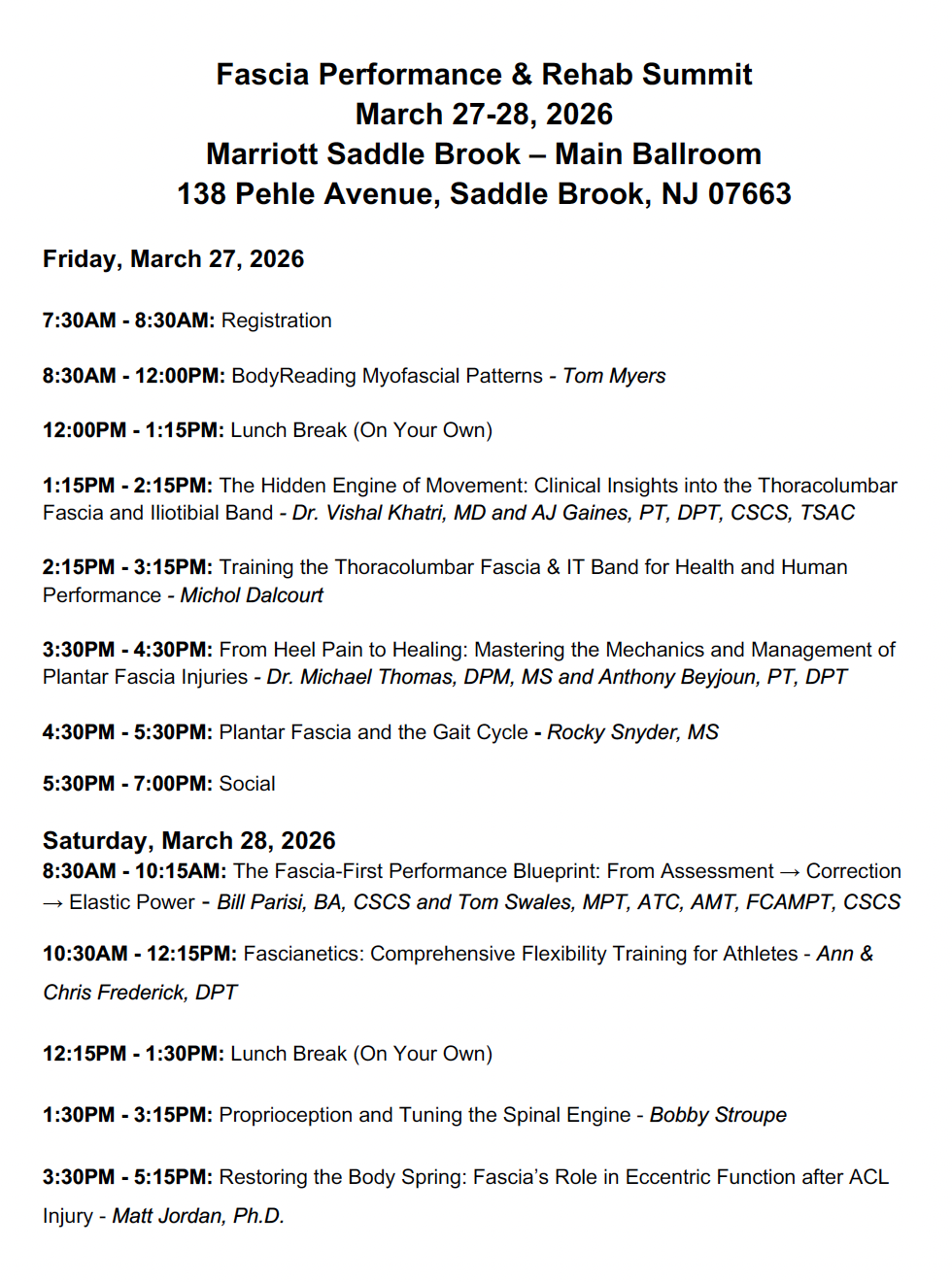


WHEN:

Friday, March 27, 2026

9:00am - 5:30pm

*Registration and Check-in will be 8:00am-9:00am*


Saturday, March 28, 2026

8:30am - 5:15pm


WHERE:

Alliance Performance

2-22 Banta Place

Fair Lawn, NJ 07410

(201) 684-9582


HOTEL RECOMMENDATION:

Marriott Saddle Brook

138 New Pehle Avenue

Saddle Brook, NJ 07663

(602) 955-3992

**Discounted rate of $129 per night. Cut off date is 2/28/26.

**Room blocks are limited availability. No guarantees. Hotel may become SOLD OUT at any time.


PRICE:

Early Bird Special Rate: $249 (When registering prior to February 27, 2026)

Pre-Registration Rate: $299


CEUS:

NSCA: TBD

NATA: TBD


2026 Fascia Training in Application Summit - March 27-28, 2026

$249.00
SKU:
2026 Fascia Training in Application Summit - March 27-28, 2026

Learn how to apply the latest fascia-aware training techniques and tools to reduce client injury-risk while improving athletic performance and enhancing overall fitness at this two-day hands-on summit featuring research-backed principles presented by top experts in the field including: Bill Parisi, Tom Myers, Dr. Vishal Khatri, AJ Gaines, Michol Dalcourt, Dr. Michael Thomas, Anthony Beyjoun, Rocky Snyder, Tom Swales, Ann & Chris Frederick, Bobby Stroupe, and Dr. Matt Jordan.

Learn how to apply the latest fascia-aware training techniques and tools to reduce client injury-risk while improving athletic performance and enhancing overall fitness at this two-day hands-on summit featuring research-…

Hurry up! only left
Total:
$249.00
Adding to cart… The item has been added
Product Details

Learn how to apply the latest fascia-aware training techniques and tools to reduce client injury-risk while improving athletic performance and enhancing overall fitness at this two-day hands-on summit featuring research-backed principles presented by top experts in the field including: Bill Parisi, Tom Myers, Dr. Vishal Khatri, AJ Gaines, Michol Dalcourt, Dr. Michael Thomas, Anthony Beyjoun, Rocky Snyder, Tom Swales, Ann & Chris Frederick, Bobby Stroupe, and Dr. Matt Jordan.


PRESENTERS & TOPICS:

BodyReading Myofascial Patterns
Presented by Tom Myers
Take your global postural pattern skills to the next level! This workshop will help you see the skeleton inside your clients. When you can put together the tilts and rotations that are part of a client’s habitual movement, you can use training, targeted stretching, or soft-tissue work to unwind the strain patterns that lead to pain, dysfunction and less-than-optimal movement.

Enhance your intuitive skills with an effective tool to map soft tissue pattern, then create strategies to progressively liberate your client’s movement range or stability.

BodyReading is useful for any bodywork practitioner, movement professionals and personal trainers – providing the information needed to deliver effective treatments and programs to create long-lasting, systemic change in clients’ shape and structure.

By the end of this session, participants will be able to:
●    Identify key global postural patterns, including common skeletal tilts and rotations, through systematic visual assessment.  
●    Assess soft-tissue strain patterns and myofascial continuities that contribute to movement limitations, pain, or dysfunction.
●    Interpret BodyReading findings to determine whether a client requires mobility, stability, or soft-tissue intervention.
●    Apply a structured BodyReading framework to develop targeted training, stretching, or manual strategies that improve functional movement.
●    Design progressive programs that address identified postural patterns to create long-term, systemic improvements in client shape and structural balance.
●    Demonstrate improved accuracy and consistency in visual assessment of posture and movement using BodyReading principles.

About Tom Myers:
Thomas Myers studied with Drs. Ida Rolf, Moshe Feldenkrais, and Buckminster Fuller, and with a variety of movement and manual therapy pioneers. His work is influenced by cranial, visceral, and intrinsic movement studies he made with European schools of osteopathy. An inveterate traveler, Tom has practiced integrative manual therapy for over 40 years in a variety of clinical and cultural settings. Tom is the author of Anatomy Trains (2020, 4th ed),  co-author of Fascial Release for Structural Balance (North Atlantic, 2010, 2017), co-author of Anatomy Trains in Motion Study Guide (2019), author of Body3, The Anatomist’s Corner, Structural Integration: Collected Articles, and BodyReading: Visual Assessment and The Anatomy Trains, and has also written extensively for Journal of Bodywork and Movement Therapies (Elsevier). He has also produced over 20 online learning courses with Anatomy Trains, and others in collaboration with various body-oriented professional groups. Tom lives and sails on the coast of Maine in the USA. Tom and his faculty conduct professional development courses and certification in Structural Integration worldwide.


The Hidden Engine of Movement: Clinical Insights into the Thoracolumbar Fascia and Iliotibial Band
Presented by Dr. Vishal Khatri & AJ Gaines, PT, DPT, CSCS, TSAC
Explore how the thoracolumbar fascia and IT band work together as key drivers of spinal and hip stability. This session blends surgical anatomy with clinical application to reveal how fascial dysfunction contributes to pain and compensation—and how preserving fascia integrity supports faster recovery and better performance outcomes.

By the end of this session, participants will be able to:

●    Describe the anatomical structure and functional relationships between the thoracolumbar fascia (TLF) and the iliotibial (IT) band as contributors to spinal and hip stability.
●    Identify common patterns of fascial dysfunction within the TLF–IT band system that lead to pain, altered mechanics, and compensatory movement strategies.
●    Explain how surgical anatomy findings enhance clinical understanding of force transmission, load sharing, and stabilization across the lumbopelvic region.
●    Assess movement and postural presentations that indicate impaired fascial integrity or disrupted myofascial continuity in the TLF–IT band complex.
●    Apply evidence-informed interventions—such as targeted loading, isometrics, soft-tissue methods, and movement retraining—to restore optimal tensioning and function of the TLF and IT band.
●    Design corrective strategies that support faster recovery, improved performance outcomes, and long-term resilience by preserving fascial health.

About Dr. Vishal Khatri:
Dr. Vishal Khatri is an orthopedic spine surgeon at Alliance Orthopedics in New Jersey, specializing in minimally invasive procedures, degenerative spine care, and recovery from spinal trauma and tumors. A summa cum laude graduate and valedictorian in Biomedical Engineering from The George Washington University, he went on to complete his medical degree there, followed by orthopedic training at Cooper University Hospital and a spine fellowship at the University of Maryland and R. Adams Cowley Shock Trauma Center. Widely published and active in leading spine societies, Dr. Khatri is known for his patient-centered approach, combining advanced surgical skill with genuine compassion to help individuals return to the activities they love.

About AJ Gaines, PT, DPT, CSCS, TSAC:
AJ Gaines, PT, DPT, CSCS, TSAC, USAW, PN-1, FRC, Animal Flow L2, is a physical therapist at Alliance Orthopedics in Freehold, New Jersey, where he has been practicing since 2016.

Dr. Gaines earned both his bachelor’s and doctorate degrees from Saint Francis University. He completed his Bachelor of Science in Exercise Physiology in 2014 and his Doctor of Physical Therapy degree in 2016. His advanced training and certifications include Certified Strength and Conditioning Specialist (CSCS) and Tactical Strength and Conditioning Facilitator (TSAC-F) through the National Strength and Conditioning Association (NSCA), USA Weightlifting (USAW), Precision Nutrition Level 1 (PN-1), Functional Range Conditioning (FRC), Animal Flow Level 2, and certification in dry needling.

Clinically, Dr. Gaines is well-versed in a broad range of evidence-based orthopedic and sports medicine approaches. He regularly integrates techniques such as Graston/IASTM, Maitland and Mulligan manual therapy, and McKenzie-based assessment and treatment. He has specialized experience treating concussions, vertigo and vestibular disorders, and temporomandibular joint (TMJ) conditions, and aims to blend hands-on care with high-level exercise prescription tailored to each patient’s goals.


Training the Thoracolumbar Fascia & IT Band for Health and Human Performance
Presented by Michol Dalcourt
The thoracolumbar fascia (TLF) and iliotibial (IT) band are two of the body’s most influential connective tissue structures—key players in stability, force transmission, locomotion, and resilience. Yet they remain widely misunderstood and often under-trained. This session demystifies their functional roles and provides a clear, practical framework for integrating TLF and IT band training into any health, fitness, or performance program.

Participants will explore foundational training guidelines for General Physical Preparedness (GPP) of these tissues—emphasizing tension management, directional loading, and multi-planar movement strategies that build durability and improve movement efficiency. We then move into a continuum of practical drills, from Anatomical Adaptation (AA) to higher-order performance sequences, showcasing how to prime the fascial system for real-world demands.

Coaches, clinicians, and practitioners will learn how to regress and progress exercises to meet the needs of diverse clients—from those requiring tissue desensitization and stability to athletes seeking elastic recoil and high-velocity expression.

Attendees will leave with a ready-to-apply toolkit for improving foundational function, enhancing performance outcomes, and developing more robust, adaptable movers through targeted TLF and IT band training.
 

By the end of this session, participants will be able to:
●    Describe the structural and functional roles of the thoracolumbar fascia (TLF) and iliotibial (IT) band in stability, locomotion, and force transmission.
●    Explain how tension management, directional loading, and multi-planar movement strategies influence the health and performance capacity of fascial tissues. 
●    Identify client presentations that require regression (e.g., desensitization and foundational stability) or progression (e.g., elastic recoil and high-velocity output) within TLF and IT band training.
●    Apply General Physical Preparedness (GPP) principles to develop baseline durability and movement efficiency in the TLF–IT band system.
●    Implement a continuum of training methods—from Anatomical Adaptation (AA) drills to advanced performance sequences—to prepare clients for real-world demands.
●    Design individualized training strategies that integrate targeted TLF and IT band work to improve foundational function, enhance performance outcomes, and increase movement adaptability.

About Michol Dalcourt:
Michol Dalcourt is an internationally recognized industry-leader in health and human performance. He is the Founder and CEO of the Institute of Motion (www.instituteofmotion.com), inventor of ViPR and ViPR PRO(www.vipr.com) and Co-Founder of PTA Global (acquired by The National Academy Sports Medicine).

Michol has served as Adjunct Faculty at the University of San Francisco in the Department of Sports Science and also as Adjunct Faculty at NAIT College School of Health  Sciences were he taught biomechanics, anatomy and exercise science.

Michol has given hundreds of international lectures and has been a featured speaker at 
many of the world’s top health and coaching conferences, and at many colleges and universities around the world. He has done extensive work in the areas of health and human performance, and consults with many of the health and performance industry’s biggest companies - including Microsoft Health, Equinox, Nike and Pennington Biomedical  -among others.

Since 2017, through his company Institute of Motion, Michol has worked with the government of Singapore to found ‘Active Health’, a nationwide initiative to scale health and  well-being to every Singaporean. The results of these efforts has helped Singapore earn the designation of “Blue Zone 2.0” (a manufactured Blue Zone) in 2024 - the first of its kind in the world. Marking a watershed moment in global health for the future.

Michol received his education from the University of Alberta in the area of Exercise Science (Faculty of Physical Education). Other certifications include C.F.C. accreditation from the Canadian Society of Exercise Physiologists.


From Heel Pain to Healing: Mastering the Mechanics and Management of Plantar Fascia Injuries
Presented by Dr. Michael Thomas & Anthony Beyjoun, PT, DPT
Understanding the plantar fascia is essential for professionals who work with clients experiencing foot pain, impaired mobility, or overuse injuries. This presentation will equip physical therapists, manual therapists, personal trainers, and coaches with the knowledge to identify early signs of plantar fasciitis, understand its biomechanical causes, and apply effective conservative treatments. Attendees will learn how early intervention can prevent chronic pain and traumatic rupture, helping clients stay active and pain-free.

By the end of this session, participants will be able to:

●    Describe the anatomy and biomechanical role of the plantar fascia in foot stability, load distribution, and gait efficiency.
●    Identify early clinical and movement-based signs of plantar fasciitis and related overuse conditions.
●    Explain the primary biomechanical and lifestyle factors that contribute to plantar fascia irritation, dysfunction, and risk of rupture.
●    Assess foot mechanics and movement patterns that predispose clients to plantar fascia stress or impaired mobility.
●    Apply evidence-informed conservative interventions—including loading strategies, soft-tissue techniques, and corrective exercise—to reduce pain and restore function.
●    Design prevention-focused programs that promote tissue resilience, reduce recurrence, and help clients maintain long-term foot health and activity levels.

About Dr. Michael Thomas:
Dr. Michael A. Thomas is a double board-certified foot and ankle surgeon at Alliance Orthopedics in New Jersey, known for his compassionate, patient-centered approach and advanced expertise in minimally invasive procedures, arthroscopy, bunion correction, reconstructive surgery, and total ankle replacement. With fellowship training from the Rubin Institute for Advanced Orthopedics and extensive experience treating everything from sports injuries to complex deformities, Dr. Thomas takes a collaborative, whole-person approach to care. He’s published in scientific journals, speaks at national conferences, and remains dedicated to helping patients stay active, independent, and pain-free.

About Anthony Beyjoun, PT, DPT:
Anthony Beyjoun, PT, DPT is a highly trained Physical Therapist at Alliance Orthopedics. He specializes in rehabilitation of orthopedic conditions and post-operative rehab focusing on decreasing pain, maximizing function, and improving performance.

Anthony attended Monmouth University, where he graduated with his Bachelor’s degree in Biology – Molecular Cell Physiology. From there, Anthony attended Stony Brook University, where he earned his Doctorate in Physical Therapy. Fieldwork experiences include work with UFC/NFL/MLB/NHL athletes, collegiate athletes, high school athletes, as well as active adults who look to improve biomechanics and reduce risk of injury. As a former athlete, he has a passion for treating athletes to facilitate a full return to sport.

Anthony is certified by the New Jersey State Board of Physical Therapy and the American Red Cross Adult and Pediatric First Aid and CPR.


Plantar Fascia and the Gait Cycle
Presented by Rocky Snyder  
Plantar Fascia and the Gait Cycle takes you on an interactive journey through the intricate dance between the foot, fascia, and full-body motion. Blending lecture with hands-on exploration, this session reveals how the plantar fascia behaves and adapts throughout the gait cycle — influencing everything from ground reaction to postural alignment up the kinetic chain. You’ll discover how movement above feeds back down to the feet, and how past injuries, surgeries, and compensations can echo through each step you take. Walk away with a deeper, more practical understanding of how to assess, restore, and optimize the foundation of human movement.

By the end of this session, participants will be able to:

●    Describe the functional role of the plantar fascia throughout the gait cycle and its influence on ground reaction forces and whole-body alignment.
●    Explain how movement patterns above the foot—at the knee, hip, pelvis, and trunk—affect plantar fascia loading and behavior.
●    Identify gait deviations and compensatory patterns resulting from prior injuries, surgeries, or chronic fascial restrictions.
●    Assess dynamic foot mechanics and fascial responses during walking to determine contributors to pain, dysfunction, or movement inefficiency.
●    Apply hands-on and movement-based strategies to restore optimal plantar fascia function and integrate improvements into the full kinetic chain.
●    Design corrective interventions and gait-focused progressions that enhance foot function, improve movement quality, and build long-term resilience.

About Rocky Snyder:
Rocky Snyder was awarded the NSCA Personal Trainer of the Year and is a nationally recognized expert in human movement, biomechanics, and performance education. With a Master’s in Sport Injury & Return to Performance Management, Rocky has spent over 30 years helping athletes and professionals alike rethink how the body moves, adapts, and performs. His innovative approach has contributed to championship success with teams such as the UConn Women’s Basketball program and extended into consulting roles with the Dallas Wings, San Jose Sharks, and LSU Women’s Gymnastics team. He continues to bridge science and practice—teaching movement professionals worldwide how to restore balance, reduce injury, and elevate athletic potential through workshops, courses, and his Zelos Podcast.


The Fascia-First Performance Blueprint: From Assessment → Correction → Elastic Power
Presented by Bill Parisi & Tom Swales
What happens when two of the industry’s most influential systems—Tom Swales’ Self-Awareness Movement (SAM) Scan and Bill Parisi’s Fascia-Driven Dynamic Warm-Up & YOO Isometric Method—merge into one integrated experience? You get a groundbreaking, fascia-first blueprint for elevating human movement, enhancing resilience, and unlocking high-performance readiness in any client or athlete.
In this high-energy 90-minute session, Tom and Bill combine functional neurology, biotensegrity principles, and fascial activation science to deliver a repeatable progression that transforms the way coaches and clinicians assess and prepare the body.

Participants will learn how to use the SAM Scan to uncover asymmetries, restrictions, and neurofascial imbalances in under three minutes—and how to immediately correct them using targeted ground-up drills that reset the nervous system and restore joint centration. The session then flows seamlessly into Bill Parisi’s Dynamic Fascial Activation Warm-Up, where attendees will experience firsthand how fascia-driven elasticity, tensioning, and directional loading create superior readiness, faster athletes, and more resilient movers.

The workshop culminates with the Fascia-First Biotensegrity Experience, where Bill and Tom coach participants through YOO Isometrics (Yielding, Overcoming & Oscillatory) to build joint health, elastic efficiency, and explosive power—the qualities most essential for long-term durability and high performance.

This session is personalized, neurological, and measurable—giving every coach, trainer, and clinician a competitive edge. Attendees will walk away with an athlete-led system that:

●    Standardizes readiness and recovery
●    Reduces injury risk through neuromotor and fascial balance
●    Improves training quality in minutes
●    Enhances performance outcomes across all sports and age groups
●    Differentiates their professional skill set and strengthens their business

This is not a warm-up.  This is a movement revolution.

By the end of this session, participants will be able to:

●    Identify neurofascial imbalances, movement restrictions, and asymmetries using the SAM Scan assessment in under three minutes.
●    Explain how biotensegrity, fascia-driven mechanics, and neuromotor control contribute to movement quality, durability, and high-performance output.
●    Apply targeted ground-up corrective drills to restore joint centration, improve proprioception, and rebalance the fascial system prior to training.
●    Demonstrate the principles of the Parisi Dynamic Fascial Activation Warm-Up to enhance elasticity, readiness, and whole-body integration.
●    Perform YOO Isometric strategies (Yielding, Overcoming & Oscillatory) to develop joint stability, elastic recoil, and power expression.
●    Design a progressive assessment → correction → activation sequence that improves session quality, reduces injury risk, and elevates athlete and client performance.


About Bill Parisi:
Bill Parisi has spent over three decades revolutionizing athletic training and education. He is the author of two well-known books, Anatomy of Speed and Fascia Training in Application, which provide in-depth insights into performance enhancement, injury resiliency, and the role of fascia in movement. His extensive background in sports science, along with a commitment to innovation in human performance, uniquely qualifies him to offer continued education and resources to professionals in the field. Through his expertise, he aims to enhance the skills of athletic trainers and performance coaches, fostering a deeper understanding of injury resiliency, athletic development, and fascia training.

About Tom Swales MPT, ATC, AMT, FCAMPT, CSCS:
Tom Swales is a physiotherapist, strength coach, and creator of the Advanced Movement Therapist (AMT) System, a fast-growing education platform used by clinicians across the world who want to elevate their rehab and performance results. With over two decades of hands-on experience working with Olympic and professional athletes as well as everyday movers, Tom is known for blending human movement, neurology, and practical coaching into strategies that make people stronger, more resilient, and pain-free.

As co-owner of COMPHYSIO+ Performance Wellness, Tom leads an interdisciplinary team focused on movement-first care and innovative technologies that shape the future of rehab. He’s also the host of the “Staying Relevant: The Future of Rehab & Performance” podcast, where he interviews top performers and explores what it takes to grow, adapt, and lead in a rapidly evolving field.


Fascianetics: Comprehensive Flexibility Training for Athletes
Presented by Ann & Chris Frederick

Fas·ci·a·net·ics: fascia (“binding”) + kinetics (“motion”)

Fascia is often used as the one word for all connective tissues (bone, blood, fat, cartilage, tendons, ligaments and more) that binds everything together from the skin down to the bone and everything in between.

Kinetics is the motion of changing position.

All body structure (anatomy) and function (physiology) must work and flow with cooperation and coordination for optimal health and performance.

Fascianetics is a proven methodology of training, rehabilitation and recovery that belongs in every system of healthcare, fitness and sports, because it is often the missing link in an optimal strategy for the individual.

There are self-guided Fascianetics programs for clients, athletes and patients of all ages. And there are Fascianetics programs that certified and licensed practitioners integrate with their current level of expertise to take their results and outcomes to another level.

In this Summit with us, learn the principles of a highly efficient functional mobility and flexibility assessment and training system that quickly tunes the body’s balance of tension and compression for optimal performance using ultra-precise hands-on techniques.

Attendees will learn how to perform a 10-minute whole-body assisted mobility micro-session for clients and athletes at both the individual and group level.

By the end of this session, participants will be able to:

●    Describe the foundational principles of “Fascianetics” and its approach to balancing tension and compression within the fascial system.
●    Explain how ultra-precise, hands-on techniques influence functional flexibility, neuromyofascial responsiveness, and overall movement efficiency.
●    Identify key indicators of fascial restriction or imbalance using the Fascianetics functional assessment process.
●    Perform a structured 10-minute whole-body assisted mobility micro-session for clients or athletes in both individual and group settings.
●    Apply Fascianetics principles to improve training and performance readiness, participation and competition outcomes, with faster and more complete recovery to maintain long-term movement health.
●    Design appropriate progressions and session applications to integrate Fascianetics into existing training, recovery, or therapeutic programs.

About Ann & Chris Frederick:
Ann Frederick is the creator of a manual and movement whole body therapy and assisted stretching called Fascia Stretch Therapy™ (FST™). Her technique was developed while a student and graduate assistant in Intercollegiate athletics at Arizona State University. While there, she conducted evidenced based research on FST for her thesis, worked with 26 different sports, worked as a stretch coach for the Men's Olympic Wrestling team and at the 1996 Olympics, and was flexibility and stretch coach for the Sun Devils when they went to the Rose Bowl in 1997. After graduation, she developed FST specifically for professional football players in America’s NFL, as well as the fastest Olympic and National Championship track athletes. Her work then evolved to the general public to address common conditions of pain, movement dysfunction and lack of flexibility. Ann now directs her school of training in FST called the Stretch to Win Institute in Chandler, Arizona, USA as well as in multiple provinces in Canada.

Chris Frederick is an integrative physical therapist/physiotherapist, practitioner of Anatomy Trains Structural Integration and practitioner of the Taoist arts of Taiji, Qigong, Baguazhang and meditation. Chris was a former professional contemporary ballet dancer and has specialized in providing manual and movement therapy for several professional dance companies including the New York City Ballet, as well as for professional athletes with his wife Ann.

Ann and Chris are authors of the books, “Stretch to Win” and “Fascial Stretch Therapy” now in their 2nd edition. Chris has co-authored chapters for 8 books including “Fascia: the human tensional network”, “Fascia in Sport and Movement” and “Fascia, Function and Medical Applications” all in their 1st and 2nd editions.


Proprioception and Tuning the Spinal Engine
Presented by Bobby Stroupe
Proprioception is the key to high-performance movement, but it’s a challenging quality to identify and train. Elite movement specialist Bobby Stroupe (who has trained Patrick Mahomes since the age of nine) explains why the neurofascial system is the superhighway for proprioception and provides functional training strategies for targeting it. Attendees will also learn how to tune the body’s “spinal engine” for increased power, stability and injury-protection.

By the end of this session, participants will be able to:

●    Describe the role of the neurofascial system in proprioception, movement accuracy, and high-performance athletic output.
●    Explain key mechanisms of proprioceptive processing and why it is difficult to assess and train using traditional strength or mobility methods.
●    Identify movement patterns and neuromuscular indicators that reflect impaired or underdeveloped proprioceptive function.
●    Apply functional training strategies that target neurofascial pathways to enhance stability, coordination, and movement efficiency.
●    Assess and influence the body’s “spinal engine” to improve rotational power, dynamic stability, and injury resilience.
●    Design training progressions that integrate proprioceptive development into performance, rehabilitation, and return-to-play programs.

About Bobby Stroupe:
Bobby Stroupe is a highly experienced trainer and the founder of the Athlete Performance Enhancement Center (APEC). With nearly two decades of directing human performance systems, he has become a renowned speaker, author, and consultant. His expertise has led him to present on various human performance topics at prestigious coach’s clinics worldwide, including the NIKE Roundtable and the China City Bowl tour. Stroupe also played a significant role in launching the CAPEC certification at Nike World Headquarters and worked with Nike Training and the Nike Young Athlete division. Additionally, he serves on the Advisory Committee for Wellness and Exercise at Tyler Junior College. Bobby continues to advise and serve on the APEC board while full-time in Kansas City training Patrick Mahomes, as featured in the Netflix documentary, “Quarterback”.


Restoring the Body Spring: Fascia’s Role in Eccentric Function after ACL Injury
Presented by Dr. Matt Jordan
Fascia is a primary driver of plyometric function, rapid force capacity and reflexive eccentric ability. But an ACL injury robs athletes of these qualities. In this session, Dr. Matt Jordan explores the critical yet often overlooked role of fascia in driving the whole-body spring in relation preventing ACL injury and restoring performance readiness after ACL reconstruction . Drawing on decades of experience working with Olympic and professional athletes recovering from knee injuries, Dr. Jordan reveals how the fascial system contributes to knee stability, force transmission, and overall movement efficiency. Attendees will gain insight into how to assess the whole-body spring in relation to fascial function and how imbalances can increase injury risk and limit performance-readiness. Practical strategies to assess, train, and restore fascial function through integrated strength, mobility, and neuromuscular approaches will be explored. This presentation bridges cutting-edge research with real-world application—offering coaches and clinicians a fascia-focused framework to enhance performance and resilience in athletes returning from ACL injury.

By the end of this session, participants will be able to:

●    Describe the role of the fascial system in knee stability, force transmission, and overall movement efficiency relevant to ACL injury risk and recovery.
●    Explain how fascial imbalances, restrictions, or altered load-sharing patterns contribute to ACL vulnerability and delayed rehabilitation.
●    Identify key assessment markers that reveal fascial dysfunction in athletes recovering from ACL injury.
●    Apply integrated strategies—combining strength training, mobility work, and neuromuscular control—to restore optimal fascial function during ACL rehab.
●    Implement evidence-informed training progressions that enhance resilience, reduce reinjury risk, and improve return-to-play outcomes.
●    Design a fascia-focused framework for ACL prevention and rehabilitation that can be integrated into clinical and performance settings.

About Dr. Matt Jordan:
Dr. Matt Jordan has been a performance consultant working with elite athletes over six Olympic Winter Games. Matt holds a Master of Science in Exercise and Neuromuscular Physiology, and a PhD in Medical Science. He is currently the Director of Sport Science at the Canadian Sport Institute Calgary and an Adjunct Professor in the Faculty of Kinesiology at the University of Calgary. His research focuses on neuromuscular adaptations to resistance training and knee injury/re-injury prevention.


DAILY SCHEDULE:


WHEN:

Friday, March 27, 2026

9:00am - 5:30pm

*Registration and Check-in will be 8:00am-9:00am*


Saturday, March 28, 2026

8:30am - 5:15pm


WHERE:

Alliance Performance

2-22 Banta Place

Fair Lawn, NJ 07410

(201) 684-9582


HOTEL RECOMMENDATION:

Marriott Saddle Brook

138 New Pehle Avenue

Saddle Brook, NJ 07663

(602) 955-3992

**Discounted rate of $129 per night. Cut off date is 2/28/26.

**Room blocks are limited availability. No guarantees. Hotel may become SOLD OUT at any time.


PRICE:

Early Bird Special Rate: $249 (When registering prior to February 27, 2026)

Pre-Registration Rate: $299


CEUS:

NSCA: TBD

NATA: TBD


2026 Fascia Training in Application Summit - March 27-28, 2026

$249.00

2026 Fascia Training in Application Summit - March 27-28, 2026

$249.00